Correlation Coefficient
The correlation coefficient (r) gives a measure of the fit of the calibration curve between the data points. It is calculated using the following equation:

where
| r | Correlation coefficient |
| wti | Weight of the data point |
| ӯ | Mean values of the measured responses or amounts If the calibration curve is forced through the origin (Origin=Force in the processing method), OpenLab CDS calculates the uncentered determination coefficient. In this case, ӯ is omitted. |
| yi | Measured response (Area, AreaRatio (ISTD method), Height or HeightRatio (ISTD method)) or amount (Amount, AmountRatio (ISTD Method)), depending on calibration mode |
| Ȳ | Mean values of the predicted responses or amounts |
| Yi | Predicted response or amount (using the calibration curve) |
ȳ and Ȳ are mean values of the measured and predicted responses or amounts, calculated as follows:
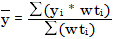
where
| wti | Weight of the data point |
| ȳ | Mean values of the measured responses or amounts |
| yi | Measured response (Area, AreaRatio (ISTD method), Height or HeightRatio (ISTD method)) or amount (Amount, AmountRatio (ISTD Method)), depending on calibration mode |
and
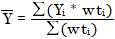
where
| wti | Weight of the data point |
| Ȳ | Mean values of the predicted responses or amounts |
| Yi | Predicted response or amount (using the calibration curve) |
For Forced Origin it is assumed that the points are centered on zero (mirrored to third quadrant) and the mean values are substituted with zero. 3rd party calculation programs may use a different approach, which will lead to slightly different results.
The correlation coefficient is 1 for a perfect fit. It reduces as the individual or averaged calibration points deviate from the regression curve. Typical values are between 0.99 and 1. The correlation coefficient is not a direct measure for precision of the analytical method, but low values indicate low precision.
base-id: 14355341579
id: 14355341579